Going solar power tiny home off-grid is one of the most rewarding decisions you can make as a tiny house dweller. Whether you’re building a tiny home on wheels (THOW), converting a shed, or constructing a permanent tiny cabin, a well-designed solar system gives you energy independence, eliminates monthly utility bills, and reduces your carbon footprint to nearly zero. In this complete guide, we’ll walk you through every component you need, how to size your system correctly, and the exact equipment we recommend for tiny home solar in 2025.
If you’re starting from scratch, our DIY off-grid solar system guide covers the fundamentals. For sizing calculations specific to your energy needs, check our solar system sizing guide. This article focuses specifically on tiny home applications.
How Much Solar Power Does a Tiny Home Need?
The first step in designing your solar power tiny home system is calculating your daily energy consumption. Tiny homes typically use 3-6 kWh per day — significantly less than a conventional home’s 30 kWh average — but the exact amount depends on your appliances and lifestyle.
Typical Tiny Home Energy Consumption
| Appliance | Watts | Hours/Day | Wh/Day |
|---|---|---|---|
| LED Lighting (5 bulbs) | 50 | 5 | 250 |
| Refrigerator (DC efficient) | 60 | 12 | 720 |
| Laptop + Phone Charging | 80 | 4 | 320 |
| Water Pump | 60 | 1 | 60 |
| Ceiling Fan | 30 | 6 | 180 |
| Induction Cooktop | 1800 | 0.5 | 900 |
| Wi-Fi Router | 12 | 24 | 288 |
| Microwave | 1200 | 0.15 | 180 |
| Total | 2,898 Wh |
A conservative tiny home without electric heating or air conditioning uses approximately 3,000 Wh (3 kWh) per day. Add a space heater, AC unit, or electric water heater and you could reach 5-8 kWh. We recommend designing your system for 4-5 kWh daily to have comfortable headroom.
👉 Check Price on Amazon – Renogy 400W Solar Panel Starter Kit
Essential Components for a Tiny Home Solar System

A complete off-grid solar system for a tiny home consists of five core components. Each one plays a critical role, and skimping on any single component will bottleneck your entire system.
1. Solar Panels
For tiny homes, roof space is your primary constraint. Most tiny houses have 150-250 square feet of usable roof area, which can fit 3-6 standard solar panels. Here’s what we recommend:
- Panel type: Monocrystalline (highest efficiency per square foot)
- Wattage: 400W panels are the sweet spot for tiny homes in 2025
- Total system size: 1,200W-2,000W (3-5 panels) for a typical tiny home
- Mounting: Roof-mounted for permanent structures, tilt-mount for THOWs
For a detailed comparison of the best panels, see our best solar panels for off-grid living guide.
👉 Check Price on Amazon – Renogy 2x200W Monocrystalline Solar Panels
2. Charge Controller (MPPT)
The charge controller regulates power flow from your panels to your batteries, preventing overcharging and maximizing energy harvest. For tiny home systems, an MPPT (Maximum Power Point Tracking) controller is essential — they’re 20-30% more efficient than cheaper PWM controllers.
- Sizing rule: Match controller amperage to your system (e.g., 1,600W ÷ 48V = 33A → use a 40A controller)
- Recommended: Victron SmartSolar MPPT 100/30 or 100/50 depending on array size
- Key feature: Bluetooth monitoring lets you track solar production from your phone
👉 Check Price on Amazon – Victron SmartSolar MPPT 100/30 Charge Controller
3. Battery Bank

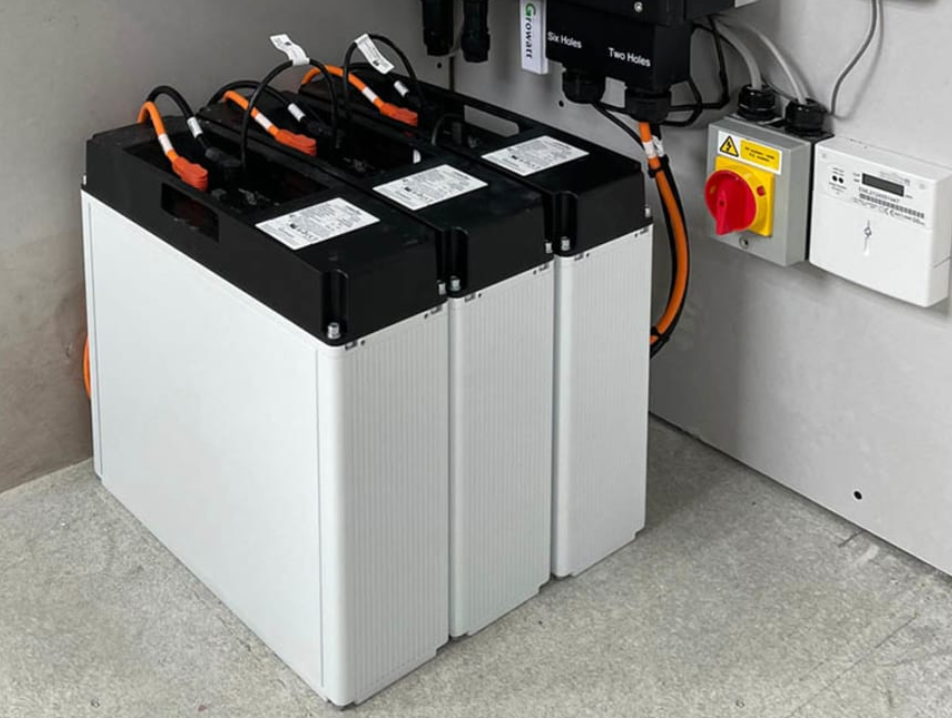
Your battery bank stores solar energy for nighttime use and cloudy days. For tiny homes in 2025, LiFePO4 (lithium iron phosphate) batteries are the clear winner over lead-acid — they’re lighter, last 10x longer, charge faster, and can be discharged to 80-100% vs. only 50% for lead-acid.
- Recommended capacity: 5-10 kWh for a typical tiny home (provides 1-2 days of autonomy)
- Best value: Server rack LiFePO4 batteries (48V 100Ah = 5.12 kWh)
- Budget option: 12V 200Ah LiFePO4 batteries wired in series for 48V
Read our deep dive: Best Lithium Batteries for Off-Grid Solar.
👉 Check Price on Amazon – Ampere Time 48V 100Ah LiFePO4 Battery
4. Inverter
The inverter converts DC battery power to AC power for standard household outlets. For tiny homes, a pure sine wave inverter is mandatory — modified sine wave inverters can damage sensitive electronics and produce annoying humming from fans and appliances.
- Sizing: 2,000W-3,000W continuous rating handles most tiny home loads
- Surge rating: Look for 2x continuous for motor startups (fridge compressor, water pump)
- Split-phase: Not needed for tiny homes — standard 120V output is sufficient
For inverter comparisons, see our guide: Best Inverters for Off-Grid Solar.
👉 Check Price on Amazon – AIMS Power 3000W Pure Sine Wave Inverter
5. Wiring, Breakers, and BOS Components
The balance-of-system (BOS) components connect everything together safely:
- MC4 connectors for panel-to-controller connections
- Battery cables: 4 AWG or 2 AWG copper for 48V systems
- DC breaker box with appropriately sized breakers for each circuit
- AC sub-panel for distributing power to outlets and fixtures
- Ground rods and bonding for electrical safety
👉 Check Price on Amazon – WindyNation 4 AWG Battery Cable Kit
Step-by-Step: Designing Your Tiny Home Solar System

Step 1: Calculate Your Daily Energy Needs
List every appliance you’ll use and multiply watts × hours of daily use. Add 20% for system losses (inverter efficiency, wiring, temperature). If your base calculation is 3 kWh, design for 3.6 kWh.
Step 2: Size Your Solar Array
Divide your daily energy need by your location’s peak sun hours. In the southern U.S. (5 peak sun hours average):
3,600 Wh ÷ 5 hours = 720W minimum array
Add 25% for real-world conditions: 720W × 1.25 = 900W recommended minimum
We suggest rounding up to 1,200W-1,600W for comfortable margins and cloudy day performance.
Step 3: Size Your Battery Bank
For 1-2 days of autonomy (recommended for off-grid):
3,600 Wh × 2 days = 7,200 Wh → 7.2 kWh battery bank
With LiFePO4 (90% usable capacity): 7,200 ÷ 0.9 = 8 kWh nominal capacity
Two 48V 100Ah batteries (5.12 kWh each) = 10.24 kWh total — perfect for a tiny home.
Step 4: Select Your Charge Controller
Match the controller to your panel voltage and amperage. For a 1,600W array at 48V system voltage:
1,600W ÷ 48V = 33.3A → use a 40A MPPT controller
Step 5: Select Your Inverter
Add up the maximum watts you might run simultaneously. For most tiny homes, 2,000-3,000W covers all scenarios including the induction cooktop.
Tiny Home Solar: Special Considerations
Roof Space Limitations
Standard tiny homes on wheels (8.5′ × 20-28′) have roughly 170-240 sq ft of roof space. After accounting for roof pitch and setbacks, you can typically fit 3-5 standard panels. If you need more capacity, consider:
- Ground-mounted panels near your tiny home
- A small solar awning or carport structure
- Higher-efficiency panels (22%+ efficiency) to maximize limited roof space
Weight Considerations for THOW
If your tiny home is on a trailer, weight matters. Solar panels add approximately 40-50 lbs each, and batteries are the heaviest component. A complete solar system adds 300-500 lbs total. Ensure your trailer is rated for the additional weight and distribute batteries low and centered for safe towing.
Heating and Cooling
Electric heating and AC are the biggest energy hogs. For off-grid tiny homes, we recommend:
- Heating: Propane or wood stove (don’t try to heat with solar in winter)
- Cooling: Mini-split AC on a dedicated solar circuit, or evaporative cooler in dry climates
- Hot water: Propane tankless water heater (far more efficient than electric)
Complete Tiny Home Solar System: Recommended Build
Here’s our recommended system for a typical 200 sq ft tiny home using 3-5 kWh per day:
| Component | Specification | Est. Cost |
|---|---|---|
| Solar Panels | 4× 400W Monocrystalline | $600-900 |
| Charge Controller | Victron MPPT 100/50 | $200-280 |
| Battery Bank | 2× 48V 100Ah LiFePO4 | $1,200-2,000 |
| Inverter | 3,000W Pure Sine Wave | $300-500 |
| Wiring & BOS | Cables, breakers, MC4s, fuses | $200-400 |
| Total | $2,500-4,080 |
This system pays for itself in 2-4 years compared to RV park electrical hookup fees ($50-150/month) or generator fuel costs.
Frequently Asked Questions
How many solar panels do I need for a tiny home?
Most tiny homes need 3-5 solar panels (1,200W-2,000W total) for comfortable off-grid living. The exact number depends on your daily energy consumption, location (sun hours), and panel wattage. A typical 400W panel produces about 1.6-2.0 kWh per day in average U.S. conditions, so 4 panels provide approximately 6.4-8.0 kWh daily — more than enough for most tiny homes.
Can I run air conditioning on solar in a tiny home?
Yes, but it requires a larger system. A mini-split AC unit uses 500-1,500W while running, adding 3-8 kWh per day to your consumption. You’ll need at least 2,000W of panels, a 10+ kWh battery bank, and a 3,000W+ inverter. In hot climates, consider a 12V DC evaporative cooler as a more energy-efficient alternative that uses only 50-100W.
How much does a complete tiny home solar system cost?
A complete off-grid solar system for a tiny home costs $2,500-5,000 for a DIY installation in 2025. The biggest cost is batteries ($1,200-2,000 for LiFePO4). Budget systems with lead-acid batteries can be built for $1,500-2,500, but we recommend spending more on lithium for the 10-year lifespan and superior performance.
What size battery bank do I need for a tiny home?
For a typical tiny home using 3-5 kWh daily, a 5-10 kWh battery bank provides 1-2 days of autonomy without sun. We recommend at least 10 kWh (two 48V 100Ah LiFePO4 batteries) for comfortable off-grid living with a buffer for cloudy days. This ensures you never run out of power during typical weather patterns.
Final Thoughts: Powering Your Tiny Home with Solar
Going solar power tiny home off-grid is more accessible and affordable in 2025 than ever before. With falling panel prices, improved LiFePO4 battery technology, and efficient DC appliances, a complete tiny home solar system can be built for under $4,000 and will provide clean, silent, free electricity for a decade or more. Start with your energy audit, size your system with generous margins, and invest in quality components that won’t let you down when you’re miles from the nearest grid connection.
Ready to start building? Browse our complete collection of solar equipment guides for detailed product reviews and installation tips.